The Issue
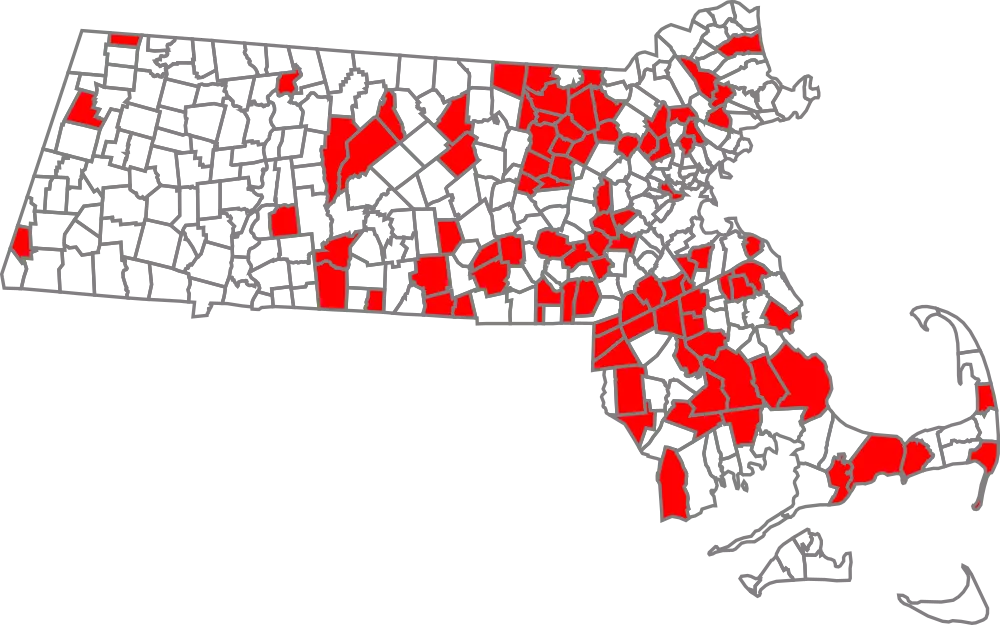
Concern has grown in recent years about the presence of PFAS at several locations across the island, including sites where firefighting foams were historically used, as well as in unexpected residential locations. PFAS contamination is of particular concern on Martha’s Vineyard because of our reliance on a sole-source aquifer for drinking water.
Amid this mounting concern, VCS has decided to provide our community with educational programming and other resources, and to collaborate with town officials to monitor and better understand the threats and opportunities for local action. The information on this page has been collected from various sources, including the EPA, Commonwealth, towns, and more.
What are PFAS?
PFAS (per- and polyfluoroalkyl substances) are a large group of pollutants often known as “forever chemicals” because of their long-term persistence once released into the environment. PFAS can be found in many different consumer, commercial, and industrial products, often used to provide resistance to water, grease, and stains; classic examples include food packaging, various sealants, and treatments for upholstery and clothing. The study of the potential human health and environmental risks of PFAS is especially challenging because of their ubiquity, the wide diversity of individual chemicals, and their frequent substitution for each other (e.g., once a given PFAS compound has been regulated or found to be toxic it can be replaced by another chemical with similar properties).
Why are we concerned?
PFAS are everywhere, but the biggest risk and strongest predictor of high PFAS levels in your body appears to be living near contaminated water. Studies have shown that exposure to some PFAS chemicals can lead to fertility issues, increase our risk of certain types of cancer, birth defects, and liver and kidney disease. The long-term effects of PFAS exposure in our environment and bodies are still being studied and are not fully understood.
What is the federal standard for PFAS in drinking water?
The EPA finalized its first nationwide regulations for PFAS in drinking water in April 2024 under the Safe Drinking Water Act, setting legally enforceable limits called Maximum Contaminant Levels (MCLs). The rule establishes extremely low limits of 4 parts per trillion (ppt) for two of the most studied PFAS—PFOA and PFOS—reflecting the lowest levels that can currently be reliably measured. It also initially set limits of 10 ppt for several other PFAS (such as PFNA, PFHxS, and GenX chemicals) and introduced a “hazard index” approach to regulate mixtures of certain PFAS occurring together. In addition, the EPA set non-enforceable health goals (MCLGs)—including a goal of zero for PFOA and PFOS, meaning no level is considered completely safe. Public water systems are required to monitor, report, and treat water if PFAS exceed these limits, with compliance timelines extending to around 2029–2031 depending on regulatory updates.
What is the Massachusetts standard for PFAS in drinking water?
The Massachusetts drinking water standard is 20 ppt for six PFAS compounds combined, higher detections trigger investigation.
What is the difference between a private and town well?
A town well is part of a public water system that supplies water to many homes and is owned, operated, and regularly tested by a local government, with treatment processes in place to ensure safety and consistent quality. In contrast, a private well serves a single home or property and is owned and maintained by the homeowner. This means that if you are on a private well, you are responsible for testing the water and installing any necessary treatment systems. While town well water is typically more regulated and monitored, private well water can vary in quality depending on local groundwater conditions and how well the system is maintained. We often overlook the health of our well water, but just like anything else on your property, it should be maintained and tested.
How do I test my private well for PFAS?
MassDEP recommends that all private drinking water wells be tested for PFAS contamination every ten years. You can read more about the state’s FAQ on private well testing on their website. We recommend testing at an EPA-approved PFAS testing facility in Massachusetts. We recommend Barnstable County Water Testing. The Wampanoag Environmental Lab on MV does not currently test for PFAS, but can facilitate testing with an outside lab.
- State Approved Testing Facilities
- Barnstable County Water Testing Lab (residential water testing)
- Chroma Chem (residential water & soil testing)
PFAS On-Island Presentation
In March 2026, we invited the community to a panel discussion featuring three well-known voices on PFAS science, education, and advocacy to help us understand the threats that PFAS (forever chemicals) pose, and offer solutions that keep us and our neighbors safe. Watch the full recording here or on Youtube by clicking the video title.
Kyla Bennet
Kyla Bennet is a former EPA regulator who is now the director of science policy at Public Employees for Environmental Responsibility (PEER).
Dr. Laurel Schaider
Dr. Laurel Schaider is a Senior Scientist at Silent Spring Institute, where she leads the Institute’s water quality research PFAS and other
contaminants of emerging concern.
Ayesha Khan
Ayesha Khan is a year-round resident of Nantucket and co-founder of Nantucket PFAS Action Group, working to spread education and awareness around PFAS.
Where have PFAS been found on Martha’s Vineyard?
Elevated levels of PFAS have been found in private wells across the island.
Neighborhoods south and east of the airport.
Year(s): 2018–present testing
Measured level:
One private well reported 848 parts per trillion (ppt)
Several other wells detected PFAS at lower levels near or below 70 ppt
Source: Firefighting foam historically used in aircraft fire training.
Wells near the fire station on Edgartown–West Tisbury Road.
Year: 2023 testing
Measured levels:
One well measured 102 ppt (designated an “imminent hazard”)
Several additional wells detected PFAS at reportable levels
Source: Firefighting foam used for training.
Private Wells near Old Stage Road, West Tisbury.
Years: 2022–2025 testing
Measured levels:
56.08 ppt in one private well (2022)
30.1 ppt in another private well (2023)
Monitoring well samples around 31.28 ppt
Later sampling found 30–55 ppt in monitoring wells (2025)
Source: Leachate from the closed landfill.
Private residences on State Road.
Year: testing completed around 2022
Measured level:
Reported as one of the highest PFAS readings in town (exact concentration not publicly disclosed)
Source: Unknown.
Martha’s Vineyard Regional High School athletic fields
Year: 2022–2023 soil testing
Measured level:
PFAS compounds detected in soil samples but below federal and state thresholds
Source: Not confirmed; possibly background contamination or historic materials.
Oak Bluffs Athletic Field, PFAS detected in soil samples in higher concentrations than the high school samples, but still below state safety thresholds.
Year: 2022–2023 soil testing
Measured level: PFAS detected in soil samples
Higher concentrations than the high school samples, but still below state safety thresholds
Source: Unknown; possibly historic materials or environmental deposition.
*sourced from coverage by the MV Times and Vineyard Gazette
Town Information on PFAS
Where are PFAS coming from?
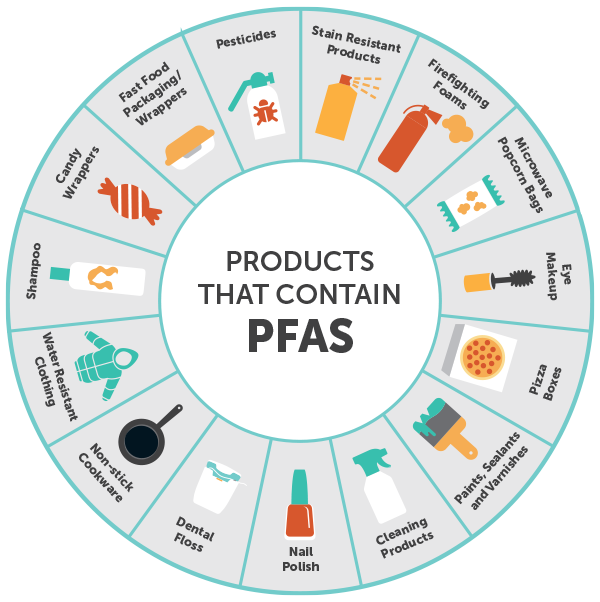
Fire extinguishing foam – in aqueous film-forming foams (or AFFFs) used to extinguish flammable liquid-based fires. Such foams are used in training and emergency response events at airports, shipyards, military bases, firefighting training facilities, chemical plants, and refineries.
Manufacturing or chemical production facilities that produce or use PFAS – for example, in chrome plating, electronics, and certain textile and paper manufacturers.
Food packaging – for example, in grease-resistant paper, fast food containers/wrappers, microwave popcorn bags, pizza boxes, and candy wrappers.
Household products – for example in stain and water-repellent used on carpets, upholstery, clothing, and other fabrics; cleaning products; non-stick cookware; paints, varnishes, and sealants.
Personal care products – for example, in certain shampoo, dental floss, and cosmetics.
Biosolids – for example, fertilizer from wastewater treatment plants used on agricultural lands can affect ground and surface water and animals that graze on the land.
Filtration Resources
If PFAS are found in your drinking water, the most important step is to reduce your exposure while confirming the level and source of contamination. Review any test results carefully and, if needed, have your water retested by a certified lab to verify the findings. If levels exceed recommended limits, switch to a safer water source for drinking and cooking. Boiling does not remove PFAS. Consider installing a certified home treatment system which are effective at removing many PFAS compounds. For further details, please refer to state guidelines. Some scientists suggest installing a filter even if you test negative for PFAS.
Actions you can take today to mitigate PFAS exposure.
Reduce consumption of plastic goods.
PFAS are frequently used in the process of making plastic goods, so, on a societal level, PFAS reduction will come through limiting our reliance on plastic products. Please join VCS in our advocacy for local and state-wide policy around single-use plastics. You can also make a difference on a personal level by switching to wood, metal or glass options where available. (Though be wary of marketing terms like “eco”, “green” or “nontoxic”, as they have no legal definition.)
Stop use of fertilizers or bio-solid fertilizers in your lawns and gardens.
Fertilizers made from biosolids (that is, concentrated nitrogen from sewage treatment facilities) often contains high levels of PFAS. In addition, some fertilizers are encapsulated in a polymer coating that breaks down over time, and PFAS are used at the factory level in this coating process. While it is not confirmed that all fertilizers contain PFAS, VCS encourages reduction in fertilizer use overall because of the impact of excess nutrients on our threatened coastal estuaries.
Purchase products that are PFAS Free.
When buying new items, look into products that can certify that they are PFAS-free.
Dispose of your waste appropriately.
While individuals can’t eliminate PFAS entirely, the way you handle waste can reduce how much of it spreads into soil, water, and air.
First, avoid sending PFAS-containing products to landfills whenever possible. Items like nonstick cookware, stain-resistant fabrics, waterproof clothing, certain food packaging (like grease-resistant takeout containers), and some cosmetics often contain PFAS. When these go into regular trash, PFAS can leach out into landfill liquid (leachate), which may contaminate groundwater. Reducing use of these products in the first place—and choosing PFAS-free alternatives—lowers what enters the waste stream.
Second, never burn household trash. Burning materials that contain PFAS (especially treated fabrics, plastics, or packaging) can release toxic fluorinated compounds into the air. Backyard burning is particularly harmful because it lacks the high temperatures and controls needed to break down these chemicals safely.
Third, dispose of hazardous household waste properly. Some items—like certain firefighting foams, industrial cleaners, or specialty waterproofing sprays—can contain high levels of PFAS. These should be taken to designated hazardous waste collection programs instead of being thrown in the trash or poured down the drain. This prevents PFAS from entering wastewater systems that are not designed to remove them.
Fourth, be cautious with what goes down the drain. Washing PFAS-containing products (like treated carpets or outdoor gear) or pouring out cleaning chemicals can send PFAS into wastewater treatment plants. Most treatment systems do not effectively remove PFAS, so they can end up in rivers, oceans, or sewage sludge that is later applied to land.
Finally, support and follow local waste guidelines and reduction programs.
Advocate for PFAS legislation.
Massachusetts has introduced several pieces of legislation in recent years to address the environmental and public health risks associated with PFAS. Find further information below on what bills are currently being proposed.
Further Education
Learn more about PFAS to understand the health and environmental effects these chemicals have on our health and environment, visit the Nantucket PFAS Action Group resource list.
Is there policy or legislation being drafted around PFAS?
Massachusetts has introduced several pieces of legislation in recent years to address the environmental and public health risks associated with PFAS. One of the most comprehensive proposals is “An Act to Protect Massachusetts Public Health from PFAS,” introduced by Julian Cyr and others. This bill seeks to reduce PFAS exposure by requiring manufacturers to report the presence of PFAS in consumer products sold in the state and by establishing a timeline to ban intentionally added PFAS in certain items such as food packaging, cosmetics, and children’s products. The legislation would also create a remediation trust fund to help pay for the cleanup of contaminated water, soil, and wastewater systems.
Other proposed bills focus on specific groups and industries affected by PFAS contamination. For example, “An Act Protecting Our Soil and Farms from PFAS Contamination” aims to assist farmers whose land or water supplies have been contaminated by PFAS, particularly from biosolids or sludge used as fertilizer. The bill would establish a relief fund for impacted farms, support testing of soil and agricultural products, and study the role of wastewater-derived fertilizers in spreading PFAS contamination. Additional legislation has focused on children’s health by requiring greater disclosure and possible restrictions on toxic chemicals, including PFAS, in children’s products.
Massachusetts has also enacted laws to protect firefighters, who face elevated exposure to PFAS through protective gear and firefighting foams. In 2024, Governor Maura Healey signed legislation requiring manufacturers to disclose whether firefighter protective equipment contains PFAS and to phase out intentionally added PFAS in such gear by 2027. Complementary proposals would fund research and development of PFAS-free alternatives for firefighting materials.