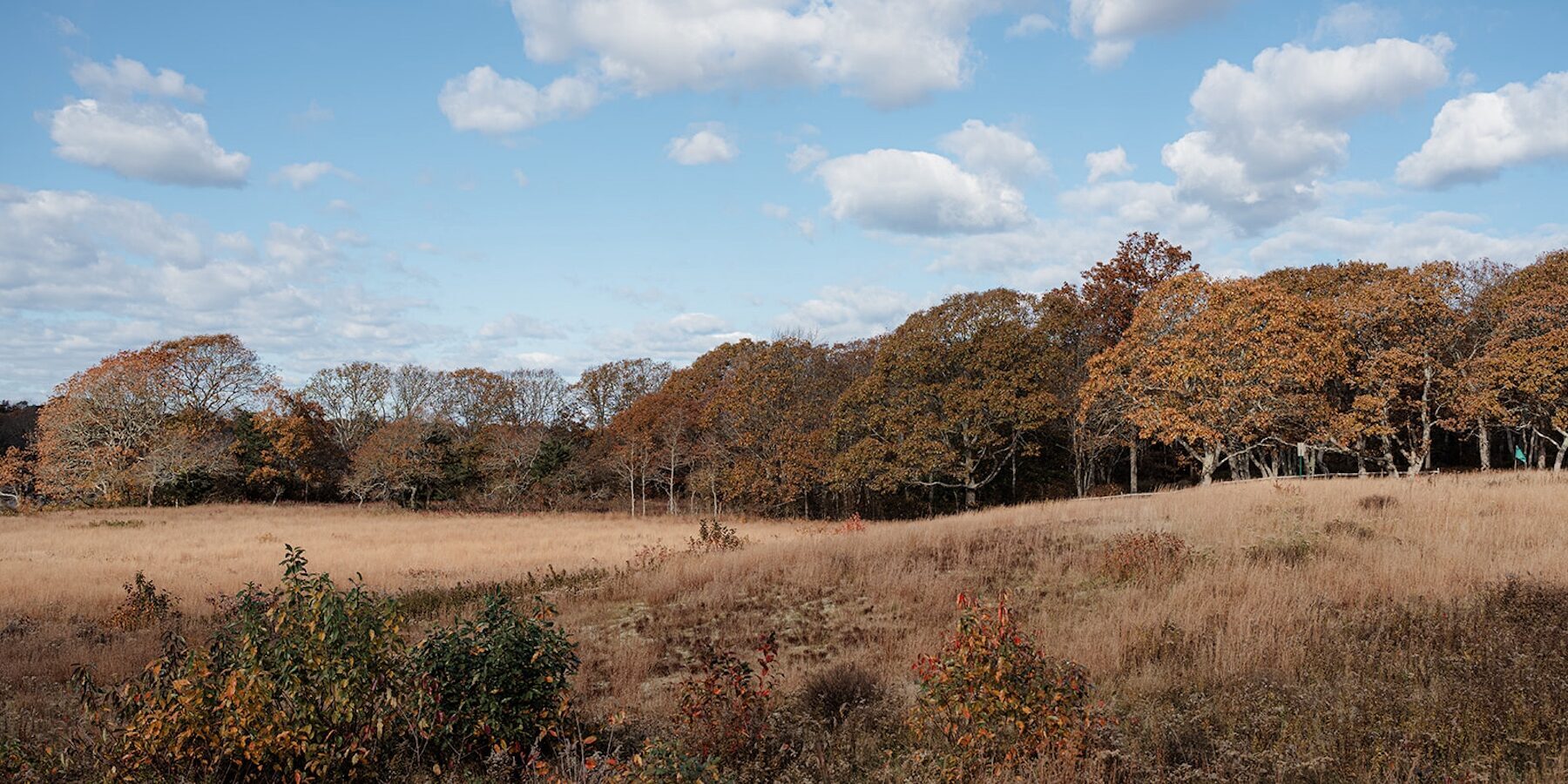
One of the most important functions of the Vineyard Conservation Society is the protection of open space, farmland, and habitat by facilitating conservation outcomes for private or public landowners. Land protection may ultimately be accomplished through outright purchase, charitable sales and gifts, or a variety of legal tools that provide flexible solutions tailored to the property and the landowner. The following summaries describe several common ways to protect land on Martha’s Vineyard
If you are interested in securing a sustainable future for the Island by ensuring your land is forever protected, contact us to learn about what we can do together.
Gifts and Charitable Sales: The most straightforward approach to land protection also maximizes the tax benefits to the landowner. When selling land to a conservation entity at a reduced price (or “bargain sale”), the difference between this and fair market value is treated as a charitable contribution. Conservation restrictions (see below) may also be donated or sold at below market value, resulting in tax benefits.
Agricultural Preservation Restriction: Similar to a CR, an Agricultural Preservation Restriction (APR) is a voluntary agreement between a landowner and the state to permanently reduce the development potential of productive farmland. The APR program offers to pay landowners the difference between the “fair market value” and the “agricultural value” of their land in exchange for a permanent deed restriction that precludes any use of the property that could negatively impact its agricultural viability. This offers an alternative to farmers and other owners of prime agricultural land who face the decision of whether to sell on the open market, helping to preserve farmland for future generations. Read more about the APR Program here.
61 Programs: Open space, farmland, and habitat can be lost to development when rising property taxes force a landowner to sell their land. Also known as Current Use Programs, Chapter 61 of the General Laws of Massachusetts provides for the temporary reduction of property taxes on land being used for agriculture, forestry, or open space and recreation. This can be an especially valuable conservation approach for the large landowner who is working toward permanent protection (via a CR or APR) at a future date but needs to ease their tax burden in the interim. Read more about Chapter 61 Programs here.
Mutual Covenants: Where protecting open space and the character of a neighborhood is important to several adjacent owners, but the benefit to the general public is not sufficient to meet the standards of a conservation restriction (CR), a mutual covenant may be a useful alternative. Landowners agree on a set of restrictions limiting future use of the land, with enforcement of the terms handled by the landowners (present and future). Mutual covenants may reduce tax liability, to the extent that the restrictions on the land are permanent

Conservation Restrictions
The Conservation Restriction (CR) is one of the most versatile tools available to Massachusetts landowners wishing to preserve their land. At its core, the CR is a landowner’s voluntary agreement to restrict the development of their land. It is a contract between a property owner (the grantor) and a conservation entity (the grantee) designed to protect the land’s important natural attributes by specifying which uses or developments (if any) will be allowed in the future. The grantee entity agrees to make sure that the provisions of the CR are not violated.
The CR document is approved by the town’s Select Board and the state Secretary of Environmental Affairs, and is then recorded with the registry of deeds. Its protection lasts forever. Current and future landowners continue to own and enjoy the private property subject to the provisions of the CR.
There are often substantial tax benefits to the landowner for donating a CR. By curtailing the right to future development, the CR reduces the value of the land asset in the landowner’s estate. In addition, the property owner is entitled to a federal income tax deduction equal to the value of the property relinquished by the gift, as determined by an appraisal. On the local level, the gift of a CR often reduces property taxes when portions of a property are rendered unbuildable. Finally, when a parcel of land encumbered with a CR is appraised for purposes of determining its value as an asset in the estate, the tax code authorizes an executor to deduct up to an additional 40% of the value.
The CR must include a description of how the public will benefit from the restriction. This demonstration of public benefit ranges from decreasing residential development density, safeguarding roadside vistas, wildlife habitat, wetland systems and drinking water supplies, to actual permission to enter onto the private land for supervised nature study, education, or other passive forms of outdoor enjoyment.
Changes in federal tax rules in the past decade have made it easier for a landowner to take full advantage of the deduction for the gift. Under the new rules, a taxpayer may deduct up to 50% of Adjusted Gross Income (AGI) per year for up to 15 years. Previous rules allowing only an annual deduction of 30% of AGI, with just a five-year carryover period, led to a common problem – especially in places of very high property values, such as Martha’s Vineyard – of the classic “land rich, cash poor” family being unable to ever utilize the full deduction. This had the unfortunate result of discouraging conservation giving and forcing sales of farmland and open space onto the open market.