Leaf Blower Regulations
In the summer of 2024, a group of citizens from across the Island, with support from VCS, got together to study what could be done to address the growing problem of noise and air pollution associated with leaf blowers. After discussion and research, the group decided that it was necessary and urgent enough to pass regulations to set day and time limits for their use, and eventually to phase out gas-powered leaf blowers entirely. Residents voted on the bylaw during 2025 Town Meetings in Chilmark, Edgartown, Oak Bluffs, Tisbury, and West Tisbury, with all five towns passing the regulation.
Bylaw by town:
Why did we regulate leaf blowers?
Noise
The noise from leaf blowers is more than just a nuisance. It impacts our health, both physical and mental. It causes hearing loss, raises stress levels, and interferes with our ability to work and our children’s ability to study. Gas-powered leaf blowers in particular are excessively loud, generating noise levels over 100 decibels at the ear of the operator and 65 to 80 decibels at 50 feet away. Even at 800 feet away, the noise exceeds 55 dB, the World Health Organization standard for community noise exposure. Notably, the decibel scale is logarithmic: every ten dB increase corresponds to an approximate doubling of loudness as perceived by humans. Further, standard dB measures underestimate the effects of leaf blower noise as compared to similarly loud noises, because their powerful low frequency component is better able to travel great distances and penetrate walls, intruding into indoor spaces.
Air Pollution
Gas leaf blowers also spew out a shocking amount of air pollution – far more than even the largest of vehicles. In one study, common leaf blower models generated about four times the nitrogen oxides, 20X the carbon monoxide, and 36 to 300X the hydrocarbons as a 6,200 pound, 411 horsepower Ford F-150 Raptor. These toxic chemicals (along with high particulate emissions) exacerbate asthma and other respiratory ailments, cause headache, dizziness, and nausea, and are associated with a wide variety of serious health effects from neurological problems to stroke, arrhythmia, and heart failure, to lymphoma, leukemia, and other cancers. These impacts are even more serious in children, the elderly, and people with preexisting conditions, and are felt especially acutely by operators.
Climate Change
In addition to their toxic emissions, the small gas engines used in lawn care equipment are simply inefficient. All small gas engines (2-stroke and 4-stroke) use more energy than comparable electric motors, partly because they are always burning fuel, even at idle, while an electric motor applies power only as needed. Two-stroke engines that burn a mix of gas and oil are especially wasteful (and polluting). It all adds up to the fact that leaf blowers are contributing far more than their share to the Vineyard’s carbon footprint – all while our island is working hard to transition away from fossil fuels.
Harm to Soil & Ecosystems
Leaf blowers blow away not only the leaves, but all sorts of other organic matter needed for healthy soil — and they just blow away a lot of the soil, too. When mulch and other protective cover is gone, it unnecessarily exposes plants to pathogens and diseases, which in turn increases the use of toxic pesticides and fungicides. Blowers disturb and even displace the beneficial insects and other critters that are vital parts of healthy gardens and natural ecosystems.
Making the Switch to Electric
What electric equipment options are available? Are they as good as gas-powered?
Electric equipment has come a long way in recent years and continues to improve, with power that rivals gas models and better reliability. The cost of batteries and recharging time are the primary challenges remaining, but many professionals have found ways to use and charge the equipment strategically and efficiently.
For a start, check out this comparison of gas and electric models; for even more info and background on going electric, check out product information and more from American Green Zone Alliance.
Are there resources available to help with purchasing electric equipment?
Yes! Mass Save offers rebates for both retail-grade ($30) and professional-grade ($100) leaf blowers, as well as similar rebates for mowers, trimmers, and chain saws. Click here to learn more. (Must be a customer of Eversource, Cape Light Compact, National Grid, or Unitil.)
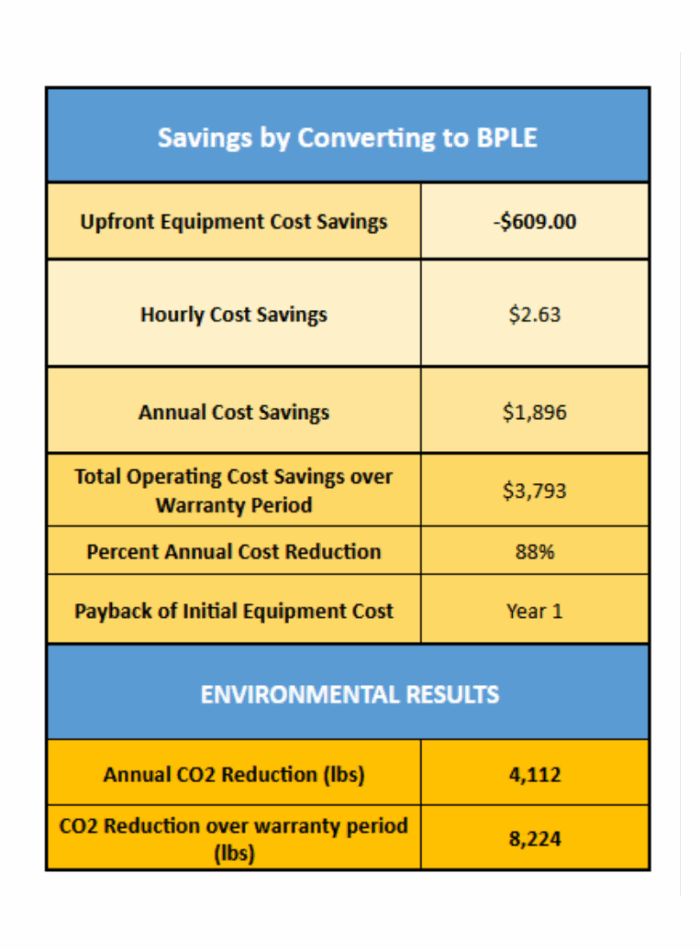
How much will investing in an electric leaf blower save me over time? How long before the initial cost is paid off?
You can calculate and compare your savings using the Equipment calculator HERE. Simply download the excel sheet and follow the instructions on the first tab. The calculator produces numbers for annual costs, savings, and the long-run payoff period. (Click image for example comparison of gas powered vs. electric powered blowers.)
Testimonials from local landscapers
“As conscientious stewards of our island community, this transition is both necessary and inevitable. However, implementation needs to be gradual and calculated, taking into account several key considerations.” (Read the rest here)
— Ryan J. White, The Avant Gardener
“We started our quest towards going all-electric for our landscape maintenance department in 2019 … considering battery usage, electric equipment costs more upfront. Despite the high initial costs, over the course of two seasons, it will eventually pay off as you will not have to pay for fuel for the electric blowers, and they require very little – if any maintenance.
Our clients and neighbors appreciate the quiet of the electric equipment we use during summer. It was a learning curve, but our employees are also happy with the electric blowers.” (Read the rest here)
— Jesse Fuller, Fullers Landscaping
“Among the biggest frustrations, beyond the noise and the fumes, is that so many “billable hours” are spent using this equipment just to fill an estimated hourly seasonal contract. Regardless of the time of the season, I have witnessed them blowing leaves or nothing at all, in or out of beds, on and off a lawn, across a patio, around a pool – blasting dust, grass clippings, or minimal amounts of vegetation just to keep things “tidy” … what a practical handheld rake or broom could do quietly and efficiently.” (Read the rest here)
— Jennie Slossberg, Garden Angels
“Consider that countless organisms live in leaf litter … among them Luna moths, Mourning cloak butterflies, and roughly 140 of Martha’s Vineyard’s native bee species, which all require leaf litter to survive the winter. The whir of a leaf blower engine is a death knell to all of them, breaking the chain in the organic cycle that perpetuates a living ecosystem. (Read the rest here)
— Rich Couse, BiodiversityWorks
What about battery recycling?
Recycling lithium-ion batteries at the end of their lives is a more sustainable approach than disposal. Approximately 95 percent of a lithium-ion battery can be recycled into new batteries, conserving critical minerals and other valuable materials. The metals used, such as lithium, nickel, and cobalt, hold their value beyond the life of the battery, allowing recycling facilities to reclaim these materials for use in new batteries or other equipment. All electric blower batteries can be recycled for free by Call2Recycle. The closest Call2Recycle drop-off location is at Staples in Falmouth, or you can ship them – check the website for instructions.
Do lithium-ion batteries pose a fire risk?
Independent studies and fire department recommendations agree that lithium batteries are safe when used properly; however, they can pose a fire risk if damaged, overheated, or improperly charged or stored. (In addition, proper storage will prolong battery life, so this just makes financial sense.) Importantly, this applies to all lithium batteries, which are commonly found today in products ranging from cell phones to golf carts. Read about proper battery storage here.
Further Reading on Healthy Lawns & Gardens
- Testimony – Battery Electric is Profitable and Powerful Enough for Landscape Contractors
- American Society of Landscape Architects – Battery Powered Equipment Helps Us All Breathe and Hear Easier
- Electrify Now! – The Advantages of All-Electric Yard Care
- Healthy Yards
- SoilsAlive – How Leaf Blowers Destroy Soil
- Four Tips for a Climate Friendly Yard
- EcoBeneficial – Good Reasons to Stop Blowing Leaves
- Vineyard Conservation Society – Vineyard Lawns
- BiodiversityWorks – Natural Neighbors Program
- Total Landscape Care – Equipment Matters: the battle for battery
- Quartz – The Complete Guide to the Battery Revolution
- Landscape Management – Battery Boom: breaking down the benefits of battery-powered equipment
- Lawn and Landscape – Plugged In